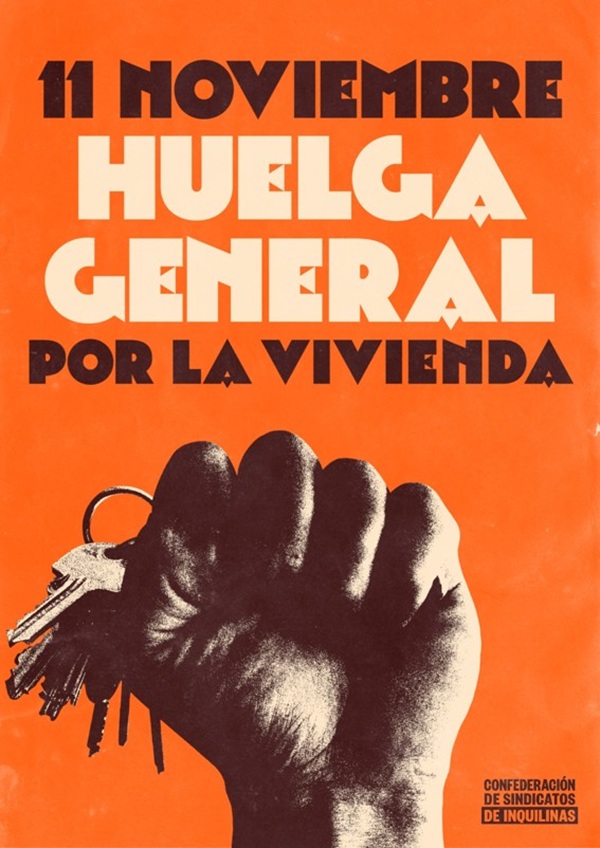
11 2026

From the Acampadas to the General Strike
On October 7, 2026, Maricarmen Abascal, an 87-year-old retiree and activist with the Sindicato de Inquilinas, died of exhaustion. Two weeks earlier, she had been forcibly and ruthlessly evicted from her apartment after 70 years, to which she had been able to return after a week following nationwide mass protests. Those two weeks also marked one of the most significant periods of mobilization in Spain since the 2011 square occupations.
Nearly ten years earlier, the first Sindicatos de Inquilinas had begun to form in Spain: tenants’ unions which, in a seemingly paradoxical way, expanded the concept of a union from its limited use in the sectorized spheres of the working world to the broader realms of housing and daily life. This new form of a tenants’ union built on the experiences of the 2011 occupation movements, of the 2015 municipalist movements and, above all, of the Plataforma de los Afectadas por la Hipoteca (PAH) – the highly successful nationwide platform advocating the rights of those affected by mortgages and evictions. In 2017, this new form of a tenants’ union was launched first in Barcelona, then in Madrid, followed by Málaga and many other cities across Spain. The obvious goals consisted in unionized and direct actions against the abuse of power by real estate companies; in campaigns against speculation and evictions; in establishing grassroots organizations that would organize tenants block by block, street by street, neighborhood by neighborhood; in exerting influence on the legislation regarding tenancy rights and on public housing policy; and, more generally, in building and expanding the movement against the total commercialization of housing and living spaces. While the Sindicato focused heavily on local-level organizing in its early years, the first Spain-wide congress and the founding of the Confederación de Sindicatos de Inquilinas took place in October 2025 at the Casa Invisible in Málaga.
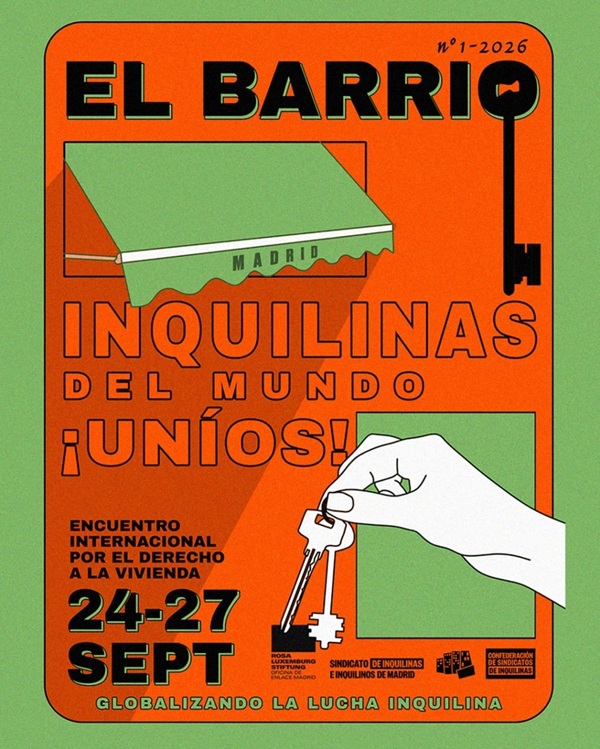
In the last week of September 2026, Madrid’s right-wing regional president, Isabel Díaz Ayuso, met with hedge funds such as Blackstone, Brookfield, and Azora at the IFEMA convention center to discuss new investment opportunities. At the same time, 70 tenants’ unions and housing movements from Europe, the Americas, and Australia had gathered for a counter-summit. They demanded rent control regulations, long-term leases, and more rights for city residents. At precisely that moment, on September 23, the real estate company Urbagestión executed an eviction in Madrid’s Retiro neighborhood. The company had Maricarmen Abascal, an 87-year-old woman who had lived in the same apartment for 70 years, forcibly carried out of her home. It could have been just another case, a case like so many others – statistically, there are 67 evictions every day in Spain. But things turned out differently. With Maricarmen’s case, a decade of organizing and struggle by housing movements across the country gained momentum – particularly the initiatives of the Sindicato Inquilinas.
¡Ni una Maricarmen más! “Not one more Maricarmen!” The Madrid Tenants’ Union, together with international Counter-Summit participants, but above all together with the activist Maricarmen herself, managed to turn her eviction into the straw that broke the camel’s back in Spain’s housing crisis. This crisis is the crisis of a model that is certainly a global manifestation of an algorithmic capitalism focused on real estate and finance. Its specifically Spanish roots lie in the Franco regime and in laws that increasingly worsen the situation in a neoliberal manner.
The rallies in the major cities exceeded all expectations, and at the Puerta del Sol in Madrid, an “acampada”, a tent encampment, was set up in the same location and with the same political aesthetic as in May 2011 when, during the 15M movement, the Puerta del Sol was occupied in the wake of the square occupations in Tunis and Cairo and a few months before the first Occupy movements in the U.S.A. Even though the generation of occupiers today is largely a new one, there are many affective echoes of that era of upheaval 15 years ago. Soon, additional acampadas sprang up in Málaga, Seville, Cádiz, Santiago, and Barcelona, and the far-right, racist slogan against refugees in Ceuta – “The problem is the invaders” – was transformed into “The invaders are the investors”. As a result, the nationalist narrative of defending Spain against migrants was eclipsed by an anti-capitalist campaign for the right to housing. The movement’s successes unfolded on many levels: most concretely in the fact that, for the first time in Spanish history, a person who had been evicted because their lease was not renewed was able to return to their apartment – at the same price and under even better conditions than before. At the same time, however, this turn of events took on a tragic note when Maricarmen Abascal died on October 7. On a political level, the result was that the government, parliament, and the media were forced to publicly discuss open-ended leases, a halt to evictions, and rent reductions – and, above all, to question the entire model in which housing is treated as a business.
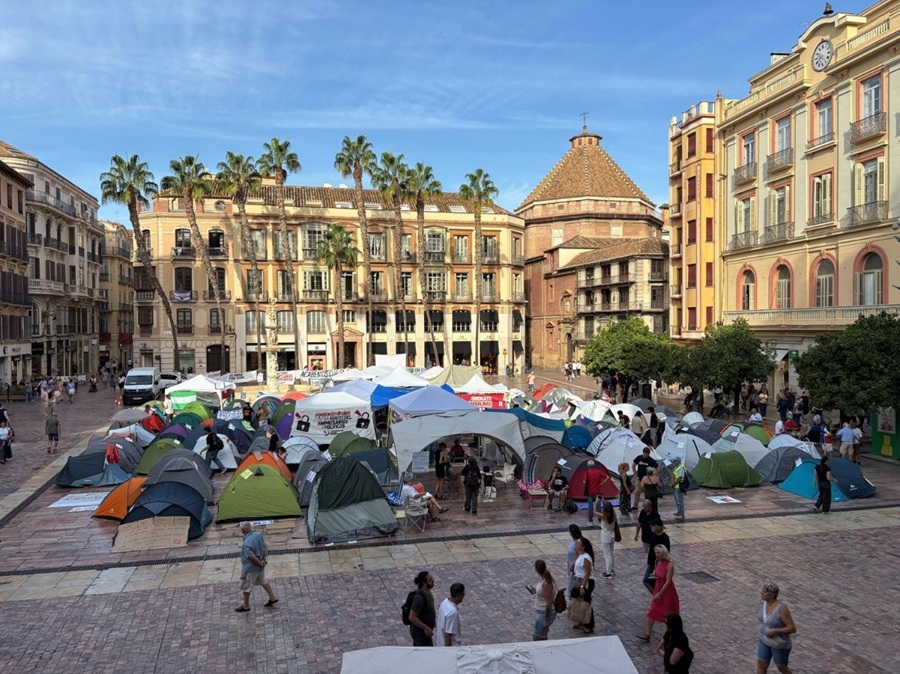
But the truly profound consequences go far beyond these specific achievements. The acampadas are anything but a symbolic occupation of public space aimed solely at pushing through a few demands. They are political testing grounds of the highest order, transforming the processes of subjectivation and collective political enunciation of an entire generation; they are, in and of themselves, an experiment in a new way of living together that – even if only temporarily – suspends the capitalist system of domination over our spaces and our lives: in the transitions, crossings, and frictions between those who, for various reasons, are accustomed to living on the streets; those who, for a certain period, relocate their modes of organization and forms of coexistence to the tents and public squares; and those who spend as much time as possible in the assemblies and working groups. The acampadas and the occupied squares show that the possibility of a different way of life exists in the midst of the smooth cities of machinic capitalism, that there is the strength and the capacity to organize against displacement, gentrification, and extreme capitalist escalations.
Following the failure of the government’s legislative proposals to reform the rental market, new elections will be held in Spain on November 29. The early elections have forced the center-left and fragmented left-wing parties—driven by labor unions and social movements—to propose more transformative policies. So much so that the Frente Amplio—the largest national electoral coalition to the left of social democracy—has nominated Ada Colau, a former PAH activist and former mayor of Barcelona, as its lead candidate, announcing that it will prioritize housing issues.
Even before that, it is also the significance of a union that will be led back to its primary terrain on the basis of the experiences gained through organizing and the acampadas. A year ago, at their congress in Málaga, the Sindicatos de Inquilinas had already proposed the general strike as their central form of action. What was then still a vague prospect has now, sooner than many expected, become very concrete: a general strike will be organized throughout Spain on November 11. In the run-up, countless assemblies are taking place in apartment buildings and neighborhoods, and strike committees are forming everywhere. However, the traditional unions, too, are being involved in the preparations for the general strike – not only as an instrument to achieve mass participation, but also to raise awareness of the housing issue as a union concern. This is not least intended to shift the perspective of traditional political organizations, so that they understand housing and urban life as a transversal issue that crosses all sectoral boundaries and affects all sectors. In this spirit – and in the tradition of radical unions in Spain, such as the CNT in Barcelona in the 1930s – a process of cooperation is unfolding in the lead-up to November 11, a process that has the potential to sustainably disrupt long-established rigid divisions between spontaneity and bureaucracy; in other words, a general strike that originates from social movements and micropolitical organizing in the barrios, yet also fully implicates traditional unions and political organizations. And all of this, not least, with the goal of transnationally organizing the housing movements in Europe. [1]